
By: Alyssa Weinrauch, CSZ-SCZ Blog Editor & PDF, University of Manitoba; Sandra Fehsenfeld, PDF, Université du Québec à Rimouski
Academia and Parenthood – what does one have to do with the other, you ask? At first sight it might not be much, but after diving into it, one quickly realizes that they both compete for the same resources: time, energy, finances, and mental health (especially during a pandemic). There is no doubt that early career researchers (ECRs) already have a lot on their plate – add caring for children into the mix, and you are asking for even longer hours, no time-outs, 24/7 of being on guard, on call, on everything.
To create a diverse and supportive environment in academia, it is crucial to acknowledge and support the needs of parents and other primary caregivers, especially during these early stages of their careers. The support for caregivers comes in many different forms, and CSZ has already made a significant effort by offering a grant to attend conferences. For this blog, we were interested in hearing from ECRs of various stages (graduate students, postdocs, junior faculty) about their experiences of being a parent while maintaining an active research career, and some challenges they have faced.
It’s a juggling act
In general, each of our interviewees agreed that today’s academic environment incorporates a growing understanding of managing a better work-life balance while still achieving a successful research career. Furthermore, social media and personal discussions increasingly delve into the pressures that parents and other caregivers in science are facing.
However, some contributors note a lack of direct and open discussion between departments and university admin. Jen Jeffrey and Caleb Hasler, both based at the University of Winnipeg as an instructor and associate professor, respectively, point out examples such as “scheduling people to teach after typical working hours or on weekends, [or] not syncing term calendars with local school calendars,” where admin may not be considering the juggling of two roles that primary caregivers face.
“I feel that most people with kids have historically felt as though they need to work harder to accomplish just as much in their career as their peers while also being an amazing parent in their ‘other life’” says Heath MacMillan, an assistant professor at Carleton University in Ottawa, Ontario. However, a number of our contributors note that this seems to be changing for the better, particularly among ECRs, where the dueling demands of academia and a home-life are being acknowledged and accepted. Anne Crémazy, assistant professor at the University of New Brunswick, specifically acknowledges working with a relatively small faculty group with many young parents, which makes it easier for people to know “where you’re coming from.”
Despite a growing appreciation for the “other lives” that parents lead, common academic tasks like publishing, obtaining funding, setting up a lab, teaching, creating lectures, and mentoring might not come as easy to parents simply due to added time and energy constraints. As Jen and Caleb say, “these are just the things you get paid to do… you also need to stay healthy, create a home, and meet a new community.” Rex Yoon, a PhD candidate at the University of Manitoba, also believes that “the fundamental problem lies in the competitive nature of academia and an overwhelming workload, which hinders the establishing of a balance between academia and having a family.” He further notes that “academia itself should lead society as a role model showing how to live a satisfactory life by balancing work and personal life.” Anne specifically mentioned the worry of grad students and postdocs to fall behind in their publication record due to parental leave and consequently being less competitive for landing a faculty position.
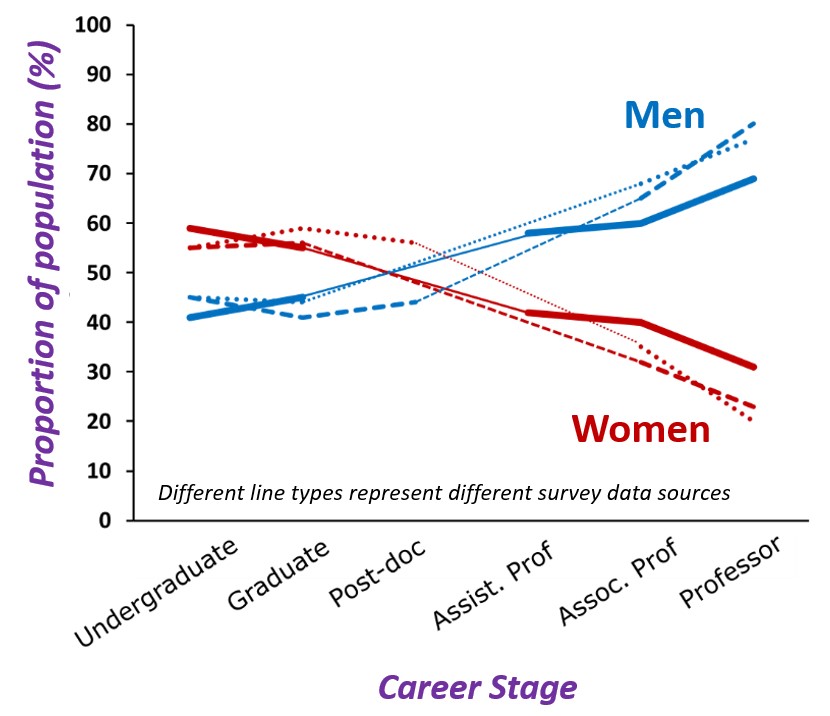
To have a successful research career, caregivers must learn how to establish a balance between their two lives and try to make it one big whole as best as they can. Our contributors commonly brought up the idea of sacrifice and learning to say “no” to ensure that boundaries are established. You can’t do everything, so you must pick and choose where to divide your time, without being too hard on yourself when something has to give. While there is no master plan to achieve this, having positive role models and mentors can help ECRs find their way. Canvassing our interviewees, it seems like supervisors with families of their own can both lead by example and set “boundaries and expectations around time set for work and for family” (Jen), but also foster discussions of “openness, honestly and vulnerability” (Heath).

Financial support for caregivers
CSZ began offering supplements for the 2019 Windsor meeting to assist primary caregivers, including parents, in attending the conference. None of our contributors could specify another conference that they had attended with a good childcare support system in place. As Sandra Fehsenfeld (PDF at Université du Québec à Rimouski and co-author of this piece) says “… the pandemic was actually beneficial as conferences moved online! This way I was able to attend … as an invited speaker… and could watch recorded presentations later as soon as the kids were in bed. That being said, the (very important) networking still fell away because in real time I could never make it.” Caleb Hasler recalls seeing “the same kid attending the conference with their parents” and how it “was neat to see him grow over time” as an interesting way to notice a lack of support at conferences!
Heath MacMillan was part of the committee that helped to initiate this funding in Windsor. When asked about his role he said “I joined this initiative because I thought it could make a real difference and promote equity and inclusion in our society. Conferences are so critical to our growth as scientists… and caregivers should not miss out on these interactions, and if alleviating one variable in that decision (money) can help in any way, I think we are under an obligation as a society to do it.” Indeed, financial constraints were commonly brought up as a significant stressor caregivers face. Rex mentions the significant pressures of raising a child on a graduate student stipend, and Anne and Sandra both discussed the significant costs of daycare that only grow as a family does.
How else can we support caregivers?
Although the CSZ has initiated some caregiver support for the conference, more can always be done. When asked for ideas, we had suggestions such as:
“simply raising awareness and keep the conversation going (via this blog!)” – Sandra
“…additional funding to this [CSZ] program as it is needed. This approach was specifically designed to be flexible, and if it is not flexible enough to accommodate the needs of all caregivers, it needs to be amended” – Heath
“We appreciate the flexibility allowed for the current support [at CSZ] offered to primary caregivers” – Jen and Caleb
“First, we need to provide more financial support for graduate students… Secondly we should promote more “baby friendly environments” at the university. This includes more nursery rooms, and increased capacity of day care on campus. Thirdly, we should organize a series of workshops for graduate students with a young family” – Rex
“The grant offered by CSZ is a good start. More financial support from the universities themselves. Establish sub-committees (i.e. for conferences) and allow kids at the meetings. Encourage and provide platforms for discussions and at meetings invite speakers on these topics” – Anne
Do you have commentary on being a primary caregiver in academia? We are going to continue our discussions on parenting in future blog posts. If you’d like to contribute in any way, please reach out to us!
Thank you to our contributors
Anne Crémazy is an Assistant professor at the University of New Brunswick in the Department of Biology. She had her first child while being a post-doc at the University of British Columbia (Vancouver) and her second at the same time that she started her faculty position.
Sandra Fehsenfeld is a NSERC PDF at Université du Québec à Rimouski and guest researcher at the University of Manitoba in comparative animal physiology (hopefully soon to add endocrinology…) with two kids (4 years old and 17 months old).
Caleb Hasler is an Associate Professor and Chancellor’s Research Chair at University of Winnipeg where his lab studies fish biology and conservation.
Jen Jeffrey is an Instructor at University of Winnipeg. She teaches mainly courses in comparative animal physiology and human anatomy and physiology. Her previous postdoctoral research focused on fish stress physiology.
Heath MacMillan is an Assistant (soon to be Associate… fingers crossed) Professor in the Department of Biology and Institute of Biochemistry at Carleton University in Ottawa, where he teaches about animals. He runs a lab full of amazing people who study insect integrative and comparative physiology and is also a father of three.
Gwangseok (Rex) Yoon is a PhD candidate at University of Manitoba under the supervision of Dr. Gary Anderson. His PhD thesis research is focused on understanding how temperature and diet during early life could impact overwintering survival of age-0 lake sturgeon in order to develop conservation strategies of lake sturgeon, a federally endangered species in Canada.
Header image from Vivek Kumar, Unsplash.