
By: Alyssa Weinrauch, CSZ-SCZ Blog Editor & PDF, University of Manitoba
As the last few days of summer come to a close, campuses across the country are welcoming (and welcoming back) their students. It’s an exciting time of year to start new classes, analyze data from the field season, and/or start thinking about those dreaded NSERC applications!
This post is CSZ-SCZ Blog’s official reminder for you to start thinking about your NSERC applications (and their looming deadlines), and provide some useful resources to help you on your way.
NSERC is offered at all levels of graduate study for Canadian citizens or permeant residents (though there are some awards like the Vanier with broader eligibility, see below). If you were lucky enough to attend the virtual CSZ meeting this past May, we had two representatives from NSERC conduct an evening Q&A to answer burning questions for each level of graduate study. Below we will highlight some of their top info and suggestions. We’ve also added in some tips and tricks that CSZ-SCZ Blog writers and editors learned from our own experience in applying and sometimes winning these awards.
Your first stop is official NSERC site, and the webpages for the award(s) you are interested in (which we’ve linked below). In all cases, make sure you know which granting agency that you are going to apply to, as you can only submit one application per year for NSERC, CIHR, and SSHRC. Historically, most work done by CSZ members falls under NSERC’s umbrella, though sometimes interdisciplinary work better fits CIHR or SSHRC’s subject matter eligibility.
A word to the wise. If you have to fill out a Canadian Common CV as part of your NSERC application – start early! Earlier than you think you’ll need. Drop down menus for every part of the CV make this a very time-consuming (and mind-numbing) task.
MSc level award – CGS-M (Deadline: Dec. 1, 8 pm EST*)
$17,500 for 12 months
The Masters level awards are adjudicated at the institutional level, meaning they never go to a national competition. For this and other awards, the best strategy is to check in with your (potential) supervisor or labmates. See if anyone is willing to edit your application or better yet, give you an old copy of their winning application. Seeing the layout of a successful application can make all the difference between being offered an award or not.
*The December 1 deadline looks to be universal across institutions, but we recommend confirming with your institution just to be sure.
Selection criteria: 50% academic excellence, 30% research potential, and 20% personal characteristics and interpersonal skills.
Did you know, when applying for the MSc NSERC, you can list up to three Canadian institutions where you would like to work? However, if you are offered an award, it must be held at the institution that granted it.
You’ll want to demonstrate a significant research component to your MSc. Note that extracurricular activities and undergraduate/first year MSc grades definitely play into your overall scores. Once you submit on December 1, sit back and try to relax as results will not be announced until April.
PhD level award – CGS-D and PGS-D (Deadline: Variable)
Important note: the deadline for these awards differs by institution. The direct to NSERC deadline (which is the latest possible deadline) is October 17 at 8 pm EST.
The PhD level NSERC awards have two different ways that you can apply: 1) through an institution or 2) directly to NSERC. If you go through the institution, there is a pre-selection process through the university, and the top applicants are forwarded on to the national NSERC competition. In most cases, you will be required to go through your institution if you are currently registered as a student.
If your university is not registered or if you are at a foreign institution, then you apply directly through the online system. If you are unsure about where to submit, see the flowchart below. Click here to see a larger version with a detailed description.
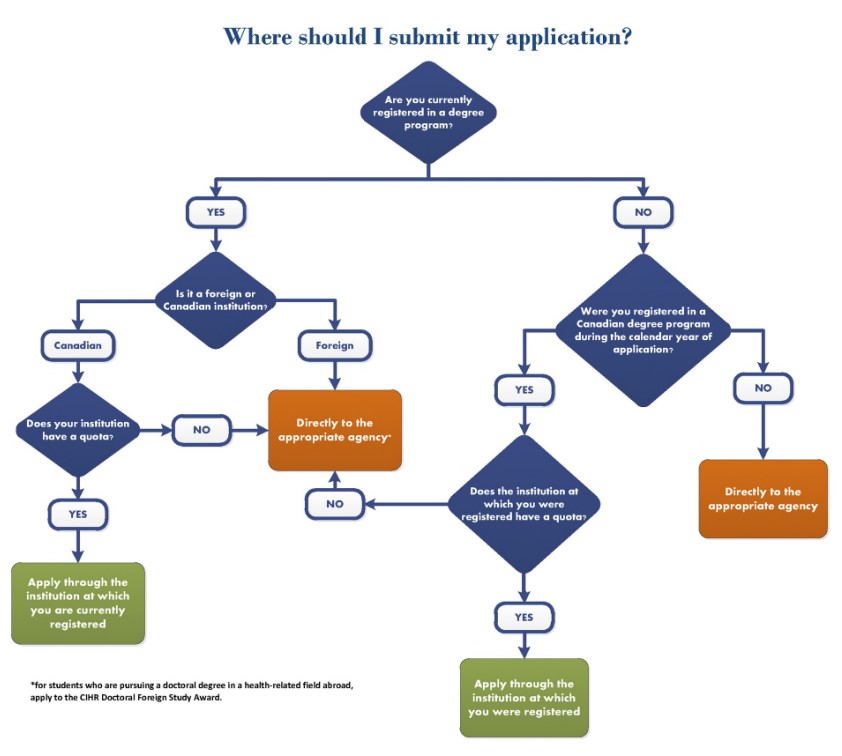
Also note, there are two different levels to the PhD awards. The PGS-D is $21,000/year for 3 years, and can be held at a Canadian institution or abroad if your previous degree was in Canada. The CGS-D is $35,000/year for 3 years and must be held at an eligible Canadian institution. The good news is that you basically apply for both with the same application. Applications are ranked and the top scores are automatically awarded CGS-D, with the next highest applicants given a PGS-D.
You can also apply for the PhD-level NSERC awards more than once, and it’s not usual to “win” it in your second or even third year of study.
Selection criteria: 50% research ability and potential and 50% relevant experiences and achievements obtained within and beyond academia.
As noted above, see if previous winners are willing to let you have a look at their application. It provides a great starting point for formatting and for what things to include in a top-notch application.
If you are unsuccessful, you are also able to request your scores from NSERC (how to do this will be included in your official results letter). They are not super detailed, and only tell you which tier you fell into for each category, but it is enough to give you a rough estimate of how you ranked with the rest of the applications in your pool for that year. A good strategic move is to identify which parts of you application were weaker, and work to improve those for the next round.
Awards are announced in April.
PDF level award – NSERC Postdoctoral Fellowship (Deadline: Oct. 17, 8 pm EST)
$45,000/year for 2 years
The postdoctoral awards are all directly submitted to NSERC. By the time you reach a PDF, you’ve proven your “unwavering dedication” to the cause, so there is a little more leeway on where you can hold the award – PDFs can change where they hold their award relatively easily.
The PDF award can be held through academic/provincial research institutions or labs in Canada or in a university or research centre abroad. Note that if you apply to hold the PDF award at a foreign institution, you must have received your PhD in Canada.
In order to apply, you must hold or expect to hold a PhD by the time you start the research. But, you can’t have fulfilled all the requirements for a PhD for more than 2 years before September 1 in the year of the application. At many universities, “fulfilling all requirements” means your defense date. Be mindful of if your defense date is before or after the NSERC deadline, as it has a big impact on your eligibility.
PDFs of years past might caution you against the “apply once in a lifetime” rule, but fear not! That restriction has recently been lifted and you can apply multiple times. With multiple attempts allowed, applying for it in your first year may be a useful practice exercise (but have a plan in case you get lucky!).
Selection criteria: 70% research ability and potential and 30% communication, interpersonal and leadership abilities
Some extra tidbits – for the PhD and PDF awards, which selection committee code you choose matters. Your application gets filtered to that committee and that committee alone, so think strategically about which you select so that you are adjudicated by the appropriate committee. You want the people reviewing your work to have the background to properly evaluate and appreciate it (thought keep in mind even the “perfect” committee will have a variety of expertise, and explaining your work in an accessible way will help a lot).
Additional NSERC Funding Programs
There are other awards offered by NSERC that we will just highlight briefly. See the NSERC website and/or contact the representatives that are specific to each award.
The Vanier awards are for “top tier” doctoral scholars who will receive $50,000/year for 3 years. Unlike the CGS and PGS awards, the Vanier is open to international students. These awards require a nomination from your institution and extra steps, so check in with your local university administrators to learn about specific deadlines, and get started early. The deadline for institutions to nominate potential Vanier scholars is November 1 at 8pm EST for 2022.
Selection criteria: Academic excellence, research potential, and leadership (potential and demonstrated ability) (weighted equally, ~33% each)
The Banting postdoctoral fellowships are to attract and retain “top tier” postdoctoral talent whether from Canada or abroad! These awards are $70,000/year for 2 years and involve a lot of up-front collaboration with your proposed institution of tenure. There are again institution specific deadlines (and sometimes pre-selection) so contact your university to learn the specifics! Keep in mind that the Banting PDF also has a limited window of time since degree completion for when you will be eligible.
Selection criteria: Research excellence and leadership, quality of proposed research program, and synergy of application and institutional strategic priorities (weighted equally, ~33% each).
Again, there are plenty more funding opportunities listed on the NSERC website so check those out and see which work for your unique situation. Best of luck!
Header image from PiggyBank, Unsplash.