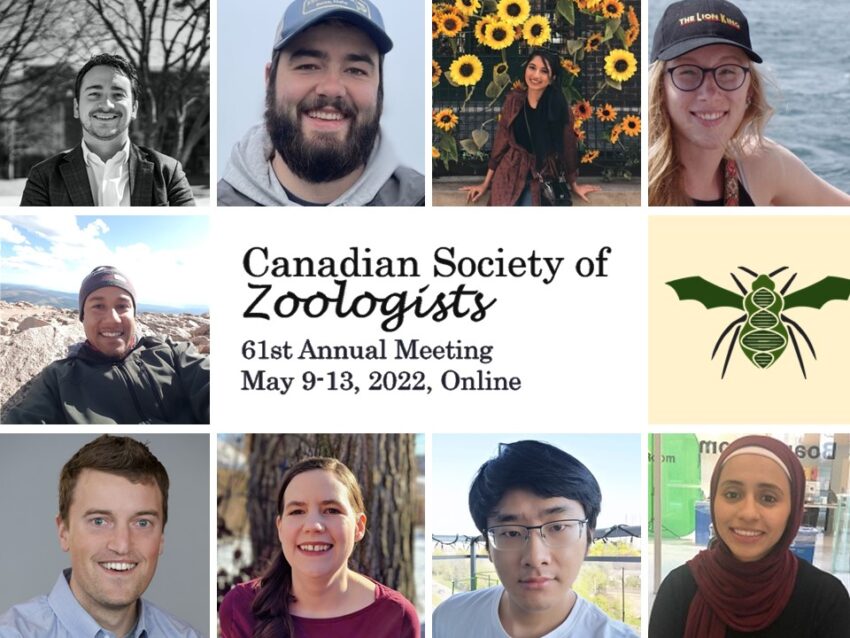
By Alyssa Weinrauch, CSZ-SCZ Blog Editor & PDF, University of Manitoba
The W.S. Hoar award is given to the best student talk at the annual CSZ meeting, while the Presidents’ award features the best talk amongst postdoctoral fellows. These sessions highlight the scientific excellence of the speaker from both a research and communication standpoint, and each year the finalists collectively wow us with their incredible and diverse work.
From insects to mammals, temperature to ion transport, and transcripts to sociality, we had excellent talks from the varied array of scientists that make up our society. Keep scrolling to learn a little bit about the contenders for each award and what they say were the successes and failures that were all a part of their research!
W.S. Hoar Award
Oliver Wearing (Winner, 2022 W.S. Hoar Award)

CSZ-SCZ Blog: Where did you complete your presented research and with whom?
OW: I completed the research I’ll be presenting for the Hoar Award Symposium in Graham Scott’s lab at McMaster University, but have been fortunate enough to have travelled to the Great Plains of Nebraska and the summit of Mt. Evans (a.k.a., albeit unofficially for now as Mt. Blue Sky) in Colorado to catch the murine grandparents of my study animals. Although the physiological data I’ll be presenting were collected by myself, any study on the deer mice wouldn’t happen without a huge concerted effort by an awesome team of researchers (fondly referred to as Team Deer Mouse) from McMaster (including Sulayman Lyons, another 2022 Hoar Award finalist!) and several other institutions in the US.
CSZ-SCZ Blog: Can you describe the research and its impact or broader implications?
OW: Much of what we know about high-altitude deer mice has come from mechanistic investigations of their improved aerobic performance in hypoxia, but much less attention has been paid to how they may also have evolved mechanisms that help them save energy in their metabolically challenging environment. Interested in filling this knowledge gap, it also struck me that there is almost no evidence of macroevolutionary variation in endotherm body temperature outside of hibernation or torpor. Considering how unavoidable the metabolic challenges of cold hypoxia are at high altitude, it seemed possible that high-altitude deer mice may be great candidates for potential evolved reductions in body temperature that may help offset the metabolic costs of endothermy in this extreme environment. Our study showed just that, providing really rare evidence that non-hibernating endotherms may manipulate their body temperature setpoint as an energy saving strategy in the face of environmental challenges to metabolism. I’m sure there are more examples out there, we just need to think about where to look!
CSZ-SCZ Blog: If your talk was a front page news headline, what would be the most eye-catching (yet accurate) title you would propose?
OW: ‘Mountain mice are cool!’
CSZ-SCZ Blog: Any notable moments, failures, successes, etc. that you’ve had on the way to gathering the presented research?
OW: This study was pretty technically challenging, largely due to the difficulties associated with remotely monitoring cardiovascular function in a relatively wild-behaving mammal as small as a mouse. Optimizing the surgical implantation protocol for our physiological telemeters to maximize the quality and impact of our results was a steep but really rewarding learning curve that has provided us with some really exciting data. Navigating these hurdles certainly makes the journey more fulfilling and I’m super excited to share the fruits of our labours with you!
Areej Dailami (Finalist, 2022 W.S. Hoar Award)

CSZ-SCZ Blog: Where did you complete your presented research and with whom?
AD: I completed this research project at the University of Toronto Mississauga, Department of Biology, with my Ph.D. thesis supervisor Prof. Angela B. Lange, co-supervisor Prof. Ian Orchard, and the postdoc Jimena Leyria.
CSZ-SCZ Blog: Can you describe the research and its impact or broader implications?
AD: Rhodnius prolixus is a blood-feeding insect that has a life cycle consisting of five nymphal stages (or instars) and a final moult to adult. A successful moult from one life stage to the other requires a single and massive blood meal. Ingestion of this large blood meal triggers diuresis to remove excess water and salt. During the rapid post-feeding diuresis, R. prolixus can transmit, through its urine, the protozoan parasite Trypanosoma cruzi, the disease-causing agent of human Chagas disease. This infection is widespread in Central and South America with 6-7 million people infected worldwide. In this paper, we characterize the glycoprotein hormone (GPA2/GPB5) and its receptor (LGR1) and we examine the physiological roles of the GPA2/GPB5 hormone-signaling pathway in relation to feeding and diuresis in R. prolixus. Understanding the glycoprotein hormone pathway and mechanisms of action could be utilized for vector control by highlighting targets to alter feeding and diuresis, hence reducing the spread of this disease vector.
CSZ-SCZ Blog: If your talk was a front-page news headline, what would be the most eye-catching (yet accurate) title you would propose?
AD: Exploring the physiological roles of the novel glycoprotein hormone (GPA2/GPB5) in the kissing bug, Rhodnius prolixus.
CSZ-SCZ Blog: Any notable moments, failures, successes, etc. that you’ve had on the way to gathering the presented research?
AD: The challenging part is the little progress made thus far toward better understanding the function of GPA2/GPB5 and the signaling pathway, particularly for the invertebrate organisms. The presented work shows, for the first time, potential physiological roles of GPA2/GPB5 in R. prolixus, where glycoprotein hormone signaling would appear to be involved during a prolonged unfed state and promote blood-gorging. The mechanisms by which GPA2/GPB5 exerts these effects are yet to be investigated.
Will Bugg (Finalist, 2022 W.S. Hoar Award)

CSZ-SCZ Blog: Where did you complete your presented research and with whom?
WB: The University of Manitoba with Gary Anderson and Kenneth Jeffries.
CSZ-SCZ Blog: Can you describe the research and its impact or broader implications?
WB: My research focuses on the responses of lake sturgeon in Manitoba to environmental stressors using a variety of whole organism fitness and transcriptional measurements. This work has implications for the conservation of lake sturgeon populations in Manitoba, sturgeon globally, and our understanding of physiological plasticity in the face of a changing climate.
CSZ-SCZ Blog: If your talk was a front page news headline, what would be the most eye-catching (yet accurate) title you would propose?
WB: Sturgeon Strained by Thermal Stress.
CSZ-SCZ Blog: Any notable moments, failures, successes, etc. that you’ve had on the way to gathering the presented research?
WB: There have been plenty of notable moments with highs and lows throughout the collection of these datasets. Lows: loss of friends and lab mates, pandemic (human), experimental failures, pathogenic outbreaks (fish). Highs: conducting field work with the lab, working with new students, gathering data that will hopefully lead to conservation impacts, collaborating with industry partners, celebrating successes with friends met along the way.
Sulayman “Sully” Lyons (Finalist, 2022 W.S. Hoar Award)

CSZ-SCZ Blog: Where did you complete your presented research and with whom?
SL: The presented work was completed at McMaster University in Dr. Grant McClelland’s Lab. I’ve also had the opportunity to do field work in the mountains of Colorado and the prairies of Nebraska and collaborate with some amazing researchers at McMaster University, University of Toronto Scarborough, University of Lincoln-Nebraska and the University of Montana.
CSZ-SCZ Blog: Can you describe the research and its impact or broader implications?
SL: The McClelland lab is interested in the adaptations associated with living in high-altitude environments, where temperatures and oxygen availability are constantly low. Specifically, my research focuses on how deer mice native to high altitude can fuel heat production to maintain stable body temperatures. Amazingly, these mice power heat production by burning fats at extremely high rates, the highest measured in any land mammal! By studying how fats are used in these mice, I have been able to shed light on the mechanisms responsible for high rates of fat burning during heat production. This research helps us further understand how the fat metabolic pathway has adapted for survival at high altitude. Furthermore, because the fat metabolic pathway is strongly conserved across mammals, a deeper understanding of how these pathways have evolved to function provides insight in studying these pathways in other physiological states, like exercise metabolic disorders.
CSZ-SCZ Blog: If your talk was a front page news headline, what would be the most eye-catching (yet accurate) title you would propose?
SL: Mice burn fats faster being cold than going for a run!
CSZ-SCZ Blog: Any notable moments, failures, successes, etc. that you’ve had on the way to gathering the presented research?
SL: I have a long list of moments, failures, and successes throughout the entirety of my research project. It has been a wild roller coaster ride! That being said, I would have to say that I’ve been extremely fortunate to have a project that I have always been excited about and I am so grateful to be a part of a supportive research group. There’s nothing like staying up late graphing the data you’ve spent so long analyzing, and then knocking on your supervisor’s door the next day with a big smile asking “Do you want to see something cool?!”
Chloé Melanson (Finalist, 2022 W.S. Hoar Award)

CSZ-SCZ Blog: Where did you complete your presented research and with whom?
CM: I completed my MSc at the Université de Moncton and Acadia University with Dr Lamarre and Dr Currie. Dr Currie was my primary supervisor and I spent most of my time in Wolfville, NS.
CSZ-SCZ Blog: Can you describe the research and its impact or broader implications?
CM: Our study aims to understand how and in which context sociality influences the physiological and behavioural responses of fish to ecologically relevant warming. My overarching hypothesis was that social stimulation affects how fish respond to high temperature. To test this, we used isogenic lineages of the tropical amphibious mangrove rivulus in different social contexts and predicted that social stimulation would affect how fish respond to increasing temperature. We provide novel insight on the influence of social context and social history on animal responses to ecologically relevant warming. It highlights the importance of considering past and present social interactions when studying thermal responses of fish and, for the first time, provides evidence that social experience may affect how fish perceive temperature. Understanding how sociality impacts thermal responses and thermal sensing in fishes is vital to predicting accurately how aquatic animals will cope with climate warming.
CSZ-SCZ Blog: If your talk was a front page news headline, what would be the most eye-catching (yet accurate) title you would propose?
CM: Being the social butterfly might get you burned: Social fish don’t feel the heat as much as loners.
CSZ-SCZ Blog: Any notable moments, failures, successes, etc. that you’ve had on the way to gathering the presented research?
CM: During my experiments, I allowed focal fish to interact with conspecifics during a thermal ramp and recorded the critical thermal maximum (CTmax) of the focal fish. We quickly realized that we might need to remove the stimulus fish before the end of the experiment since their CTmax might be lower than the focal fish’s and we did not want to expose them to dangerous temperatures. However, removing the stimulus fish would need to be done without disturbing the focal fish. Thus started a quest for a quick fish removal tool – inserts, nets and pipettes all proved inefficient and left us scratching our heads. Finally, during a lab meeting, eureka! A quick trip to the dollar store and I had my fish removal tool in hand, a turkey baster! The turkey baster ended up working perfectly allowing me to pick up our tiny fish without creating too much water disturbance. Who knew?!
Another part of my study required us to expose mangrove rivulus to capsaicin, a molecule found in hot peppers, to stimulate their thermal receptors. No study had previously exposed this species to capsaicin and the small size of our fish presented an additional challenge as we could not expose them via injection – the most common exposure method. Through lots of troubleshooting, I eventually found the correct combination of capsaicin concentration, water mixing, water volume and titration volume to expose fish to capsaicin through water. Finding a capsaicin delivery method without affecting the behaviour of our fish ended up being the trickiest part of my experimental design!
Farwa Sajadi (Finalist, 2022 W.S. Hoar Award)

CSZ-SCZ Blog: Where did you complete your presented research and with whom?
FS: I completed my research at York University, Toronto, Canada under the supervision of Dr. Jean-Paul Paluzzi.
CSZ-SCZ Blog: Can you describe the research and its impact or broader implications?
FS: Insect post-prandial diuresis is under rigorous control by neuroendocrine factors, acting on the Malpighian ‘renal’ tubules to regulate urine production. Our research focuses on investigating the physiological roles of an insect neuropeptide, CAPA, and its contribution to mosquito (Aedes aegypti) osmoregulation via its direct actions on the tubules. Our research is on the verge of elucidating the signaling mechanism involved in CAPA inhibition, an area of endocrine regulation that is not well understood. Investigating the pathway of CAPA inhibition and its role in countering diuresis will help provide a deeper understanding of the critical process of diuresis and its signaling mechanism. Studying the excretory system and understanding the underlying mechanisms behind ion and fluid transport may aid in developing novel pest management strategies, subsequently controlling Aedes population and its role as a disease vector.
CSZ-SCZ Blog: If your talk was a front page news headline, what would be the most eye-catching (yet accurate) title you would propose?
FS: “To pee or not to pee: the mosquito question”
CSZ-SCZ Blog: Any notable moments, failures, successes, etc. that you’ve had on the way to gathering the presented research?
FS: All research comes with its phases of success and failure. This work took about three years to collect, with COVID obviously causing some obstacles along the way. The most notable failure would have to be during our cGMP measurements using the enzyme-linked immunosorbent assay, where I had dissected over 400 female mosquitoes, conducted the experiment, only to have it not work because we didn’t add a phosphodiesterase inhibitor. My biggest success has to be the immunohistochemistry results – after months of work, I am super pleased with our images, with clear indication of the dissociation of the V-ATPase.
Presidents’ Award
Dr. Kevin Pan (Winner, 2022 Presidents’ Award)

CSZ-SCZ Blog: Where did you complete your presented research and with whom?
KP: My research was completed at the University of Ottawa under the supervision of Steve Perry.
CSZ-SCZ Blog: Can you describe the research and its impact or broader implications?
KP: My research examines the oxygen signaling pathway in larval zebrafish. To our knowledge, this is the first research to utilize in vivo calcium sensors to look at the oxygen chemoreception and signaling pathways in live fish. With the present anthropogenic effects resulting in increased hypoxic zones in watersheds, this would allow us to better understand how fish sense environmental oxygen changes and how these hypoxic zones would affect them.
CSZ-SCZ Blog: If your talk was a front page news headline, what would be the most eye-catching (yet accurate) title you would propose?
KP: Fish “taste” changes in oxygen levels.
CSZ-SCZ Blog: Any notable moments, failures, successes, etc. that you’ve had on the way to gathering the presented research?
KP: Generating, and especially validating, transgenic lines is hard. It takes a lot of patience and trial-and-error to get a single transgenic line working.
Dr. Erin Brandt (Finalist, 2022 Presidents’ Award)

CSZ-SCZ Blog: Where did you complete your presented research and with whom?
EB: I completed this work at Western University in Natasha Mhatre’s lab, along with a group of fantastic undergrads who helped with data collection and who also became co-authors.
CSZ-SCZ Blog: Can you describe the research and its impact or broader implications?
EB: Crickets produce calls to attract mates. Because loud calls reach more potential mates, some crickets build and use tools to increase their sound radiation efficiency, making themselves louder. But only about 5 of the over 6000 known cricket species use these tools. This project investigated why acoustic tool use in crickets is rare. We hypothesized that non tool using crickets don’t stand to gain much from tool use and may use a different strategy to increase efficiency. To test this, we first gathered data from 113 species of crickets, on the size of their sound radiators (wings) and on the frequency of the sounds they produce. We then used these data to inform biophysical models, which calculated wing sound radiation efficiency with and without acoustic tools. By simulating different biologically relevant calling conditions, we tested whether tool users were the ones that stood to gain the most from their use. The models included a ground, vegetation, and a variable distance between the caller and the ground. We found that indeed, some groups of crickets do not stand to gain much from tool use, but the group containing tool users did. We also found that singing from the ground may be an alternative strategy to boost efficiency, and that some crickets could gain as much or more efficiency using this strategy.
Broadly, this study shows how biophysical models can be brought to bear on questions related to the evolution of behavior. By combining data from real animals, and biologically relevant modeling scenarios, it is possible to both test existing hypotheses and generate new ones. We can also capture the behavior of extinct species, or even putative species, allowing us to think about the evolution of different morphological and behavioral traits in these ‘missing links’.
CSZ-SCZ Blog: If your talk was a front page news headline, what would be the most eye-catching (yet accurate) title you would propose?
EB: Some insects use tools to improve the acoustics, others just stay well grounded.
CSZ-SCZ Blog: Any notable moments, failures, successes, etc. that you’ve had on the way to gathering the presented research?
EB: A big challenge was to find the data we needed on cricket wing size and song frequency. These data can be extremely difficult to find, especially for understudied groups of crickets. Sometimes we had to glean information from very old papers in other languages. Sometimes we had to painstakingly assemble collages of wing images that weren’t taken at quite the correct angle. I bet the cricket enthusiast in 1920s Germany never could have imagined that their data would be used to inform sophisticated biophysical models! I think this really shows the value in publishing good descriptive studies and natural history data – you never know how it might be used by future generations of scientists.
Dr. Ciarán Shaughnessy (Finalist, 2022 Presidents’ Award)

CSZ-SCZ Blog: Where did you complete your presented research and with whom?
CS: The short answer is at the Conte Anadromous Fish Research Center (United States Geological Survey) with Dr. Stephen D. McCormick.
As I described in my extended abstract, the long answer is a bit trickier. The novel work that I am presenting was entirely conceptualized and performed during my postdoctoral training years via an ongoing collaboration I have maintained with Dr. McCormick. The findings I’m presenting are answers to a question that eluded me during my doctoral research with Dr. McCormick, and that I have since pieced together in my postdoctoral years of training. In my last three years, I have had independent fellowship funding through the National Institutes of Health (mentored by Pamela L. Zeitlin, PhD MD at National Jewish Health in Denver, CO; 2019-2021) and the National Science Foundation (mentored by Robert M. Dores, PhD at the University of Denver; current position). I sought out these fellowships and mentors to learn the science and techniques that I have needed to answer the questions about ancient vertebrate ionoregulatory physiology which I will be presenting in this symposium.
CSZ-SCZ Blog: Can you describe the research and its impact or broader implications?
CS: This work describes a newly discovered Cl– secreting cell type found in the gills of the ancient vertebrate, the sea lamprey (Petromyzon marinus). In seawater-adapted fishes, a single cell type that was originally termed the ‘chloride cell’ and is now referred to as the ‘SW-type ionocyte’ is responsible for maintaining Cl– homeostasis. This cell type is characterized by the rich co-expression of basolateral transporters Na+/K+-ATPase (Nka) and Na+/K+/2Cl– cotransporter (Nkcc1) with the apical cystic fibrosis transmembrane conductance regulator (Cftr) Cl– channel serving as the primary route of apical Cl– secretion. Here, I describe that the sea lamprey use a different Cl– secreting branchial cell type to achieve Cl– homeostasis in seawater. This new cell type expresses the apical Cl– channel anoctamin 1 (Ano1/Tmem16a), not Cftr, as the apical route for Cl– secretion.
This finding has important implications of both evolutionary and biomedical consequence. This work implies that an Nka-, Nkcc1-, and Ano1-rich ionocyte on the branchial epithelium of seawater-adapted fishes may have pre-dated the Nka-, Nkcc1-, Cftr-rich ionocyte present in more derived seawater-adapted fishes, thus inspiring discussion regarding the evolution of the fish gill as a Cl– secreting epithelium and why a Cftr-rich ionocyte emerged in later derived fishes. This finding will also be of interest to researchers studying cystic fibrosis (a lung disease caused by Cftr dysfunction). Researchers studying cystic fibrosis have long-sought an alternative apical Cl– channel that could be a therapeutic target to replace the function of Cftr in the Nka-, Nkcc1, Cftr-rich pulmonary ionocytes, and Ano1 has been a leading candidate in this regard. The discovery I am presenting here of a Nka-, Nkcc1-, Ano1-rich Cl– secreting ionocyte represents a cellular pathway that confirms that Ano1 can function in place of Cftr in such an ionocyte, thus inspiring investigations into the development of this cell type on the epithelial surface.
CSZ-SCZ Blog: If your talk was a front page news headline, what would be the most eye-catching (yet accurate) title you would propose?
CS: An ancient cell type discovered in a pre-historic fish could offer insights into research on cystic fibrosis.
CSZ-SCZ Blog: Any notable moments, failures, successes, etc. that you’ve had on the way to gathering the presented research?
CS: Oh mackerel… certainly lots of failures I could mention here. This work has been a journey of scientific investigation that has broadened my purview as a comparative physiologist to include the biomedical world and solidified my interest in leading an independent research program drawing on a diverse array of experiences and laboratory techniques. I think the most eye-opening aspect of this project, through which I learned the most about myself as a scientist, was how willing I was to try to prove myself wrong. After discovering the potential role of Ano1 in this sea lamprey branchial ionocyte, I found myself in the role as my own greatest skeptic. I spent a great deal of time reading and researching to prove my finding was wrong, and I still do. Such skepticism has a historical and central role in the scientific method, yet it was a role I had not found myself in before. The idea that I could be so willing to prove myself wrong has revealed to me the true extent of my passion for using science to find truth in understanding novel aspects of animal physiology.
The W.S. Hoar and Presidents’ awards are always highlights of the annual meeting and celebrate some of the best up-and-coming talent in the society. Congratulations to all finalists and winners!