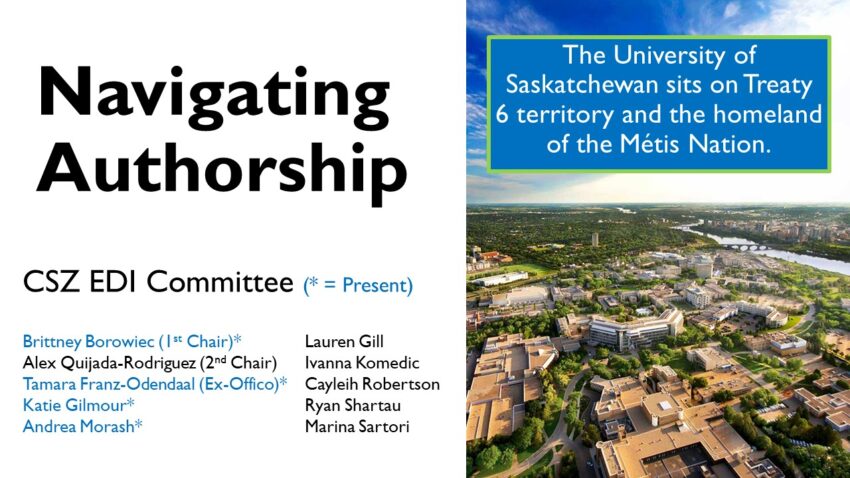
By: Brittney G. Borowiec, 1st Chair, CSZ EDI Committee (2022-2023); Managing Editor, CSZ-SCZ Blog; & PDF, University of Waterloo
Academic authorship is important and messy. It is a major criterion for scholarships, grants, job applications, and awards. It is also something that every person seems to approach differently based on their training and experiences. Academic authorship practices reflect the EDI challenges observed in other academic spaces – for example, how women are under-credited compared to their male-presenting colleagues, and there are field-dependent inequities across race and gender.
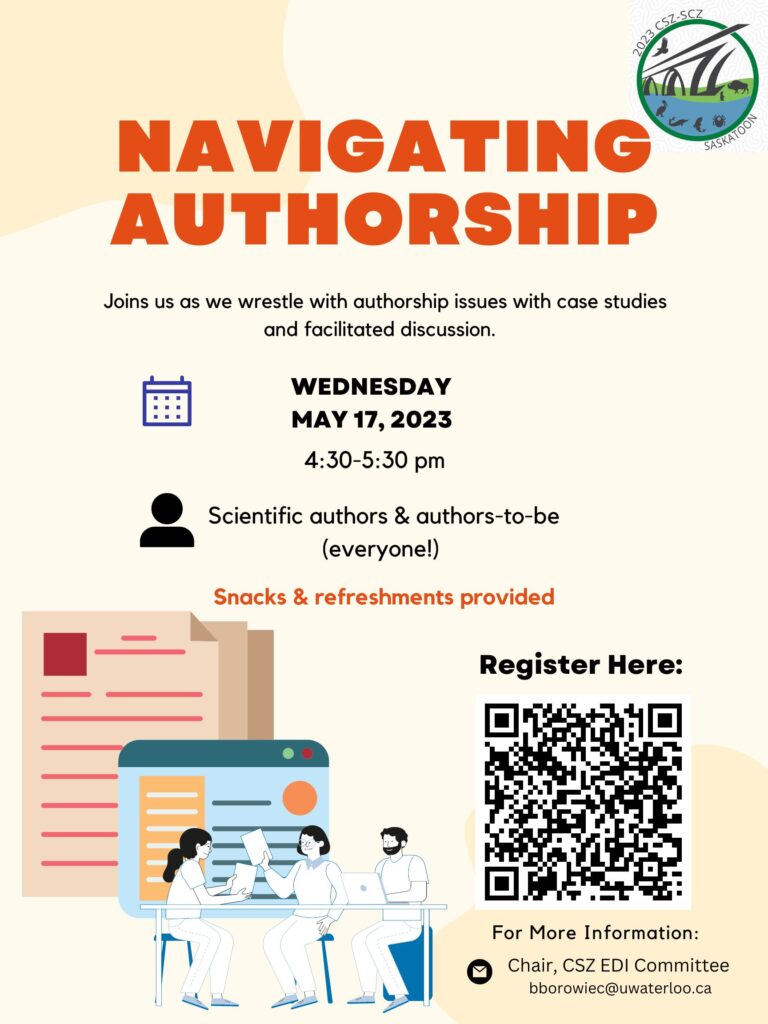
Building a more equitable, diverse, and inclusive society includes critically examining our authorship practices. About 60 to 70 participants began the “Navigating Authorship” workshop by sorting themselves into small “breakout” groups and reviewing three fictional (but realistic) scenarios of potential authorship conflicts. The scenarios were crafted by members of the EDI committee and relevant to a variety of career stages. Following unstructured discussion within each group (spurred on by guiding questions), participants engaged in a facilitated group discussion about the scenarios and their personal experiences with academic authorship.
Scenario 1: Publishing with a “missing” student
Scenario 1 covered a common but sticky problem in research labs: what happens when an author disappears? This particular scenario focused on publishing the 2-year-old thesis of a graduated student, who showed no interest in publishing since leaving the lab. As is typical of thesis student projects, the supervisor designed and funded the project and gave significant feedback on the thesis writing.
Participants agreed this scenario was realistic, and some expressed that they felt this situation seemed to be arising more often now than in the past. A popular solution was to be proactive: ask new lab members sign a publication agreement that sets out the conditions under which data can be published without including them as an author, including periods of inactivity or unresponsiveness after leaving the lab.
As for the scenario (where no publication agreement existed), participants generally agreed that an unresponsive student could not be included as author, as authorship also denotes a certain level of responsibility for the work), but that they could certainly be included in the acknowledgments. Before “bumping down” the student from author to acknowledgment, it is important to make every effort possible to find them, including perhaps contacting their parents or sending a registered letter to the student’s place of employment. However, caution and sensitivity are warranted, especially when trying to track down students through non-traditional means, as people may be unresponsive for many different valid reasons.
Scenario 2: Did the work but it is not in the paper
Scenario 2 hits on one of the most frustrating aspects of science: despite considerable effort, sometimes things just don’t work out. Our main characters were a postdoctoral fellow (PDF), who has a near-complete dataset but no time to finish it off, and an undergraduate student, who agreed to complete the last few experiments in exchange for authorship. Where things get muddy is that the undergraduate student’s results are “not as expected” and therefore do not end up in the paper after all, leaving them in limbo as to whether they are still owed authorship or not.
There was a general lack of consensus for this scenario. Some participants were uncomfortable with the idea of promising authorship at all, or of excluding results that were “not as expected.” Participants did agree that the conditions for authorship should be clear and, ideally, decided upon much earlier than depicted in the scenario.
One straightforward assessment focused on whether the data appeared in the manuscript or not: if so, then authorship is warranted. Others opined that it would be unfortunate for the undergraduate student to put so much otherwise uncompensated work into a project (especially considering the high value of authorships for trainees). As a compromise, it was suggested that the PI and PDF could find other ways for the student to contribute (and “earn” authorship) aside from data collection, such as by drafting parts of the manuscript.
Scenario 3: Help from another lab’s PhD student
Scenario 3 was perhaps the most complicated as it focused on the nuances of acknowledgment vs. authorship in a collaborative environment. A MSc student is drafting their first manuscript for submission to the Journal of Experimental Biology (JEB) (read their authorship guidelines here), which emphasises that an author is “someone who has made significant and substantial contributions to a study.” JEB’s guidelines also note that contributions such as “providing reagents or assisting with the writing” belong in the Acknowledgments.
The MSc student’s lab is small and newly established by a recent hire to the department. Without any senior graduate students in their own lab, the MSc student relied on a senior PhD student from another lab in the department for help, advice, and troubleshooting. The PhD student also taught them how use some communal equipment and let them borrow some reagents (which the MSc student later replaced). The MSc student included the PhD student as an author on the manuscript. The PhD student’s PI, a senior faculty member, has made it known that they are upset that they are not also included as an author.
Much of the discussion of this scenario focused on the need for clear communication and navigating the complex power dynamics of the situation. Early conversations focused on the responsibility of senior researchers to self-regulate and adhere to personal ethics by being willing step away if they have not contributed sufficiently to a project to warrant authorship. One participant shared a personal example where, as an advisory committee member, she was added as an author without consultation to a manuscript, emphasizing that it is not always the actions of a senior researcher that can lead to situations of unwarranted authorship. Similar to Scenario #2, participants suggested a solution to Scenario #3 could be finding additional ways for the senior PI to contribute (writing, analysis, etc.) and “earn” authorship on the manuscript.
The discussion then turned to how the students could navigate this scenario. Had the senior student discussed the collaboration with their PI? Checking in early on might have facilitated a more balanced workload or lead to drawing up a formal authorship agreement with responsibilities laid out much early on. Plus, PhD student probably should give their own PI a heads up before committing substantial time and effort to other projects, especially if it could interfere with their own progression.
Did the PhD student agree that they should be an author? How should a student or postdoctoral fellow balance being offered a valuable authorship when they feel they did not do enough to warrant it (despite their potential co-authors’ actions)? More broadly, how can a trainee say no to a senior PI? Most journals have authorship checklists, which may be helpful for clarifying these situations, though they are much more difficult to enforce when there are complex power dynamics at play. Participants emphasized the importance of the MSc student’s PI, or perhaps a trusted and independent committee member, to support and help avoid awkward situations with power dynamics.
Key Learnings
Authorship conundrums are almost inevitable for academics, and there is no single approach to resolving them. We suggest three guiding principles for navigating authorship:
Everyone’s experience with authorship is different. Each experience is valid and instructive. Planning is important. Ideally authorship questions and concerns should be anticipated and resolved before they can arise. Open communication is important, especially when unanticipated situations arise. |
The EDI committee was pleased with the quality and breadth of the discussion, and thankful to all participants who shared their thoughts and experiences. The committee hopes that CSZ members continue the discussion of navigating authorship at lab meetings, in their department, and elsewhere.
For copies of “Navigating Authorship” resources, such as full scenarios with guiding questions and introductory slides, please contact Brittney G. Borowiec directly or send an email to the CSZ-SCZ Blog Team (csz.scz.blog@gmail.com).